

CSRD and ESRS: compliance for companies operating in Europe
Double materiality, 12 ESRS standards (E1-E5, S1-S4, G1) and mandatory disclosures. Mangue Tech structures the full report.
Companies that trust Mangue Tech









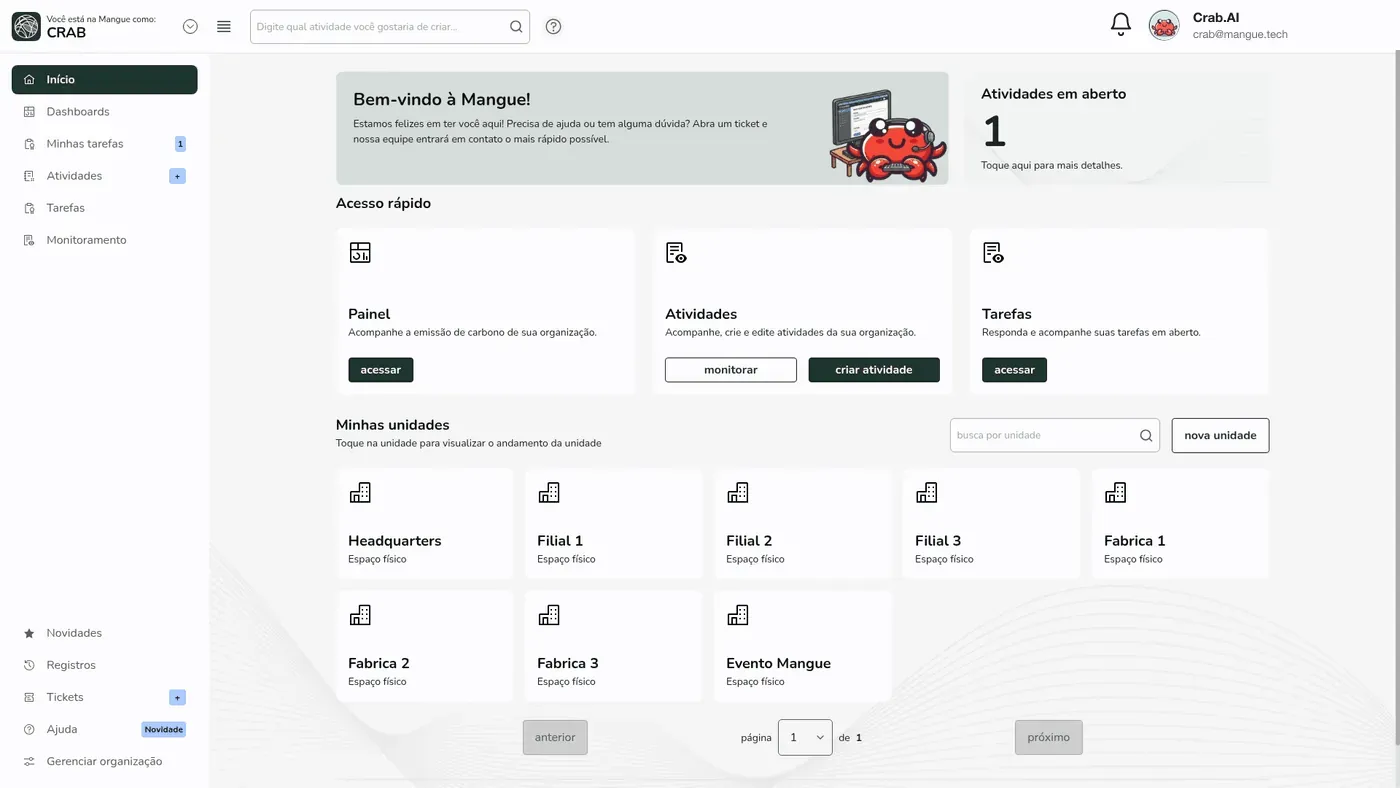
Consulting + Platform
Operational data becomes auditable ESG indicators.
Specialist consulting that understands CSRD / ESRS. A platform that automates the calculation, versions the data and exports it in the format the regulator requires.
Consultoria
ESG data and compliance management, with a specialist who knows your sector.
Plataforma
Our own software, automating calculations, indicators and exports.
Auditable reports
GHG inventory, decarbonization plan and reports ready for the auditor.
Less time
Automated collection vs. manual spreadsheet.
Global frameworks
IFRS, CSRD, CBAM, GRI, SASB, GHG, CDP…
Emission factors
IPCC, DEFRA, MCTI, EPA, Ecoinvent.
How Mangue works
4 steps. From diagnosis to an auditable report.
Diagnosis
Find out which ESG risks affect your business and what the regulator will require.
Estrutura
Organized data, defined processes and everything ready for any verification.
Operation
Emission calculations, decarbonization targets and continuous monitoring.
Auditable reports
Active compliance with IFRS, CSRD, CBAM, GRI, SASB and GHG Protocol.
Mangue deliverables for CSRD / ESRS
Every delivery is a complete package: consultant + platform + auditable report. Click to see how we apply it.
The framework
What it is, and why it matters.
The Corporate Sustainability Reporting Directive (CSRD) is the European regulation that replaces the NFRD and sharply widens the range of companies required to report ESG. From 2025-2026, it reaches thousands of companies in the EU and subsidiaries of non-European groups.
The European Sustainability Reporting Standards (ESRS) define the 12 topical standards: E1 (climate change), E2 (pollution), E3 (water), E4 (biodiversity), E5 (resource use and circular economy), S1-S4 (own workforce, workers in the value chain, affected communities, consumers) and G1 (business conduct).
Double materiality requires the company to assess both the financial impact of ESG topics on itself and the impact of its own operations on people and the environment.
At scale
When the standard updates, the calculation engine is already up to date.
supported frameworks
GHG Protocol, CSRD, IFRS S2, CDP, GRI, SASB, CBAM, SBCE. One single database.
emission factors
IPCC, DEFRA, MCTI, EPA, Ecoinvent. All versioned, with source, year and gas.
scopes covered
Scopes 1, 2, 3 and biogenic. Operational and financial. Everything goes in.
Aplicabilidade
Who it applies to.
- Companies operating in the European Union that meet at least two of three criteria: revenue above €50M, assets above €25M, more than 250 employees.
- Brazilian subsidiaries of European groups that consolidate reporting under CSRD.
- Large exporters that have to meet due diligence requirements in European supply chains.
How we deliver
From source to auditor.
We run the double materiality assessment with internal and external stakeholders, identifying which ESRS topics apply.
We structure the mandatory data points for each applicable standard, combining emissions data (E1) from the platform with qualitative governance and social information.
We deliver the ESRS-ready draft report, with a gap analysis and a roadmap for the topics still in development.



The IFRS S1 & S2 Roadmap: the 12 decisions your CFO must make before 2027
A practical guide for CFOs, IR Directors, Controllers and Accounting. ~15 min read, straight to your inbox.
We got your info! Camila will send you the IFRS S1 & S2 Roadmap by email shortly.
Perguntas frequentes