Engineering
“I feel like things are faster now. To me, efficient means time. The idea is to have a system, a platform, not just a spreadsheet to fill in.”

Oscar Freire
ESG Lead · Voke

Assessment, an abatement cost curve by industry, 1.5°C targets and submission to the Science Based Targets initiative.
Companies that trust Mangue Tech










Consulting + Platform
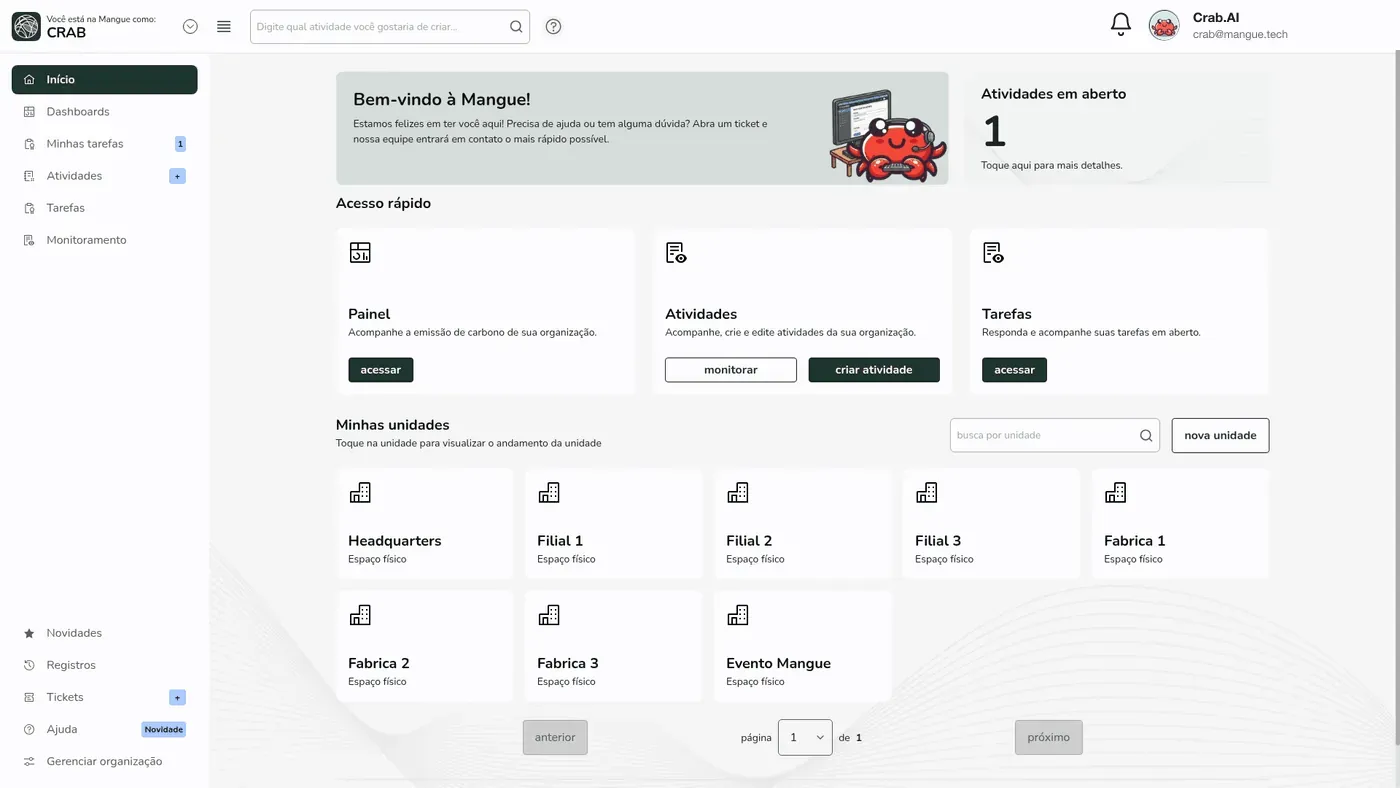
Specialist consulting that understands decarbonization. A platform that automates the calculation, versions the data and exports it in the format the regulator requires.
ESG data and compliance management, with a specialist who knows your sector.
Our own software, automating calculations, indicators and exports.
GHG inventory, decarbonization plan and reports ready for the auditor.
Less time
Automated collection vs. manual spreadsheet.
Global frameworks
IFRS, CSRD, CBAM, GRI, SASB, GHG, CDP…
Emission factors
IPCC, DEFRA, MCTI, EPA, Ecoinvent.
How Mangue works
Find out which ESG risks affect your business and what the regulator will require.
Organized data, defined processes and everything ready for any verification.
Emission calculations, decarbonization targets and continuous monitoring.
Active compliance with IFRS, CSRD, CBAM, GRI, SASB and GHG Protocol.
Mangue deliverables for decarbonization
Every delivery is a complete package: consultant + platform + auditable report. Click to see how we apply it.
Frameworks we apply
The service
A decarbonization plan turns the inventory into action. It starts from an assessment of the emission sources, ranks reduction opportunities by cost-effectiveness (MAC curve) and sets quantitative targets aligned with climate science.
Mangue Tech builds the plan to SBTi criteria: a minimum 4.2% cut per year in scopes 1 and 2 (near-term 2030) and 90% coverage of total emissions for net-zero (long-term 2050). We include an action roadmap by time horizon.
The plan covers real levers: energy efficiency, electrification, a move to renewables through Brazil's free energy market (ACL), supplier engagement in Scope 3 and, where needed, offsetting the residual through REDD+.
Delivery
Etapa 01
We start from the existing inventory to diagnose the emission sources and build the marginal abatement cost curve (MAC).
Etapa 02
We set near-term (2030) and long-term (2050) targets aligned with SBTi, with an action roadmap by time horizon.
Etapa 03
We deliver the plan with real levers. Energy efficiency, electrification, renewables, value chain engagement. And we support the submission to SBTi.
Users comment
Engineering
“I feel like things are faster now. To me, efficient means time. The idea is to have a system, a platform, not just a spreadsheet to fill in.”
Textile industry
“Today we can say we have consistent, organized data that lets us keep improving going forward. That's the platform's main role: giving us visibility into something that wasn't visible to everyone before.”

Carbon Neutral Badge
Whoever measures, reduces and offsets the residual with a certified Carbonext credit moves from Aware to the Carbon Neutral Badge. From measurement to neutralization, with public proof.

Frequently asked questions
Diagnostics, scope and proposal on the same day. Straight with the specialist who will run the project.